"You should write a book": why memoirs wait for "one day"
Anyone who tells a good story at dinner has heard it. Why the memoir keeps waiting for "one day", and how to save a story in ten minutes before the details fade.
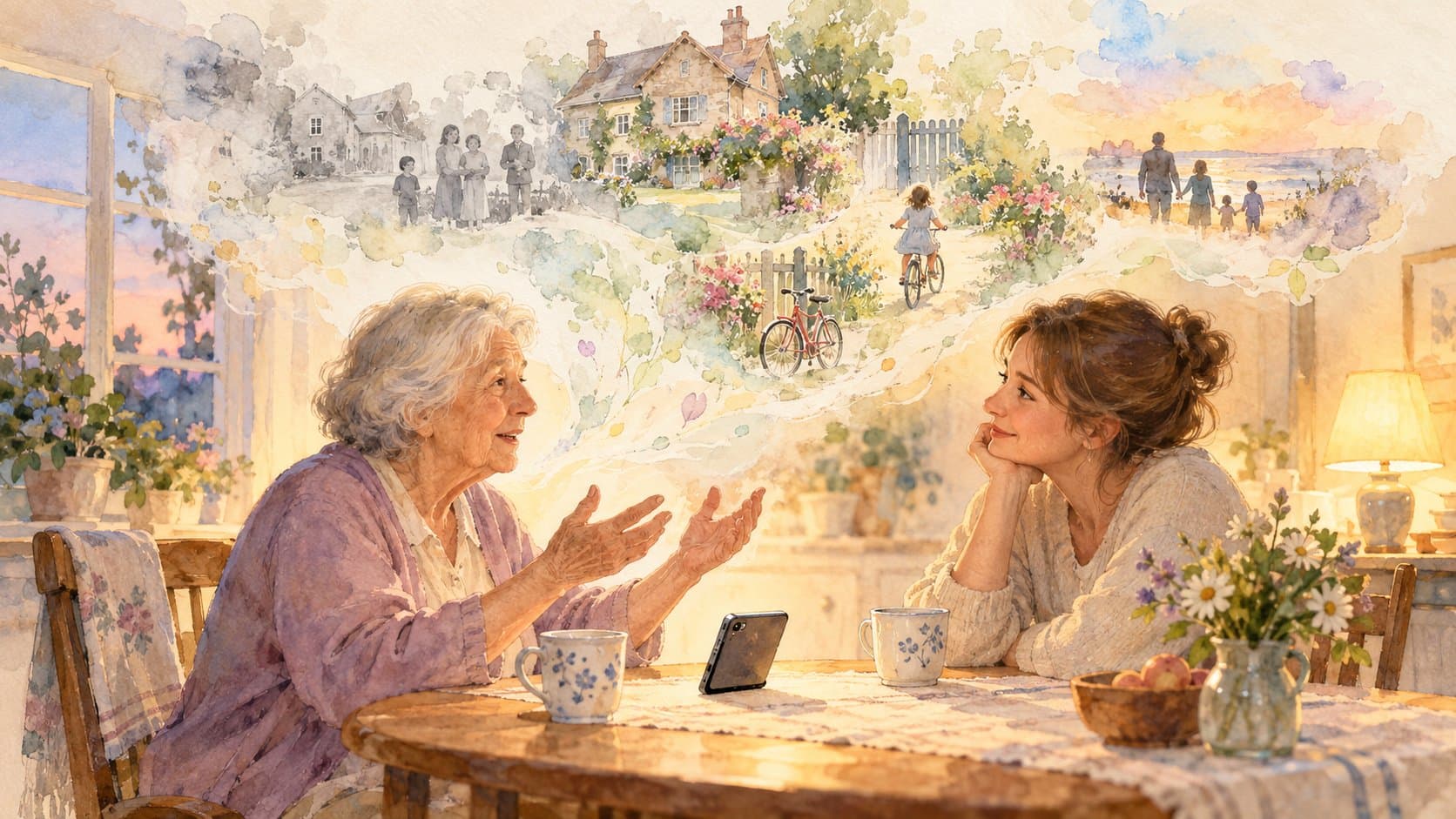
You know the moment.
A family dinner, the plates cleared, the second bottle open. Someone says "remember when…", and off you go. The summer of '93, when you and your dad drove a fridge home strapped to the roof of a tiny Fiat. How it started sliding off at the very first roundabout. How Walter from next door jogged alongside, holding it in place with one hand.
The table is in stitches. Someone wipes their eyes. And then, as always:
"Honestly, you should write a book."
You smile. "One day."
Try counting how many times you've heard that. Now count how many times you've said it yourself, to your dad, your gran, the friend who tells stories better than anyone.
What "one day" really means
Usually it means "when I have time". When the kids are grown, when you retire, when things calm down. In your head, a book is a big project: a desk, silence, a manuscript from birth to now. The sort of thing you start at the end.
The trouble is, there's never a convenient end. Something always happens next. A grandchild arrives, you move house, you lose someone, or life takes an unexpected second wind. A book put off until later just keeps waiting.
The other "one days"
Sometimes "one day" has nothing to do with time. It's a polite no, with something else behind it.
"My life isn't that interesting." Almost everyone says this before they start. We won't argue. Tell one story, then another. After a few evenings, you'll probably see what's hard to see from the inside: how one decision at twenty set off everything after it, how many times you started over, how many people walked alongside you. People aren't surprised because their life turns out to be a film. They're surprised it has a logic of its own, and that they're seeing it whole for the first time.
"It feels a bit embarrassing." Talking about yourself is unusual, fair enough. But if you don't tell it, nobody will know. Your grandchildren will have a date of birth, a few photos and a couple of anecdotes. The rest will vanish, important or not. And you alone decide what goes into the book and what stays out.
"I'm no writer." You don't need to be. You just talk, the way you do at that dinner table. The questions come from our biographer, an AI interviewer. It listens, asks follow-ups, points out what you haven't covered yet, and tells you why it's asking. The text is built from your own words.
The quiet trap
The fridge story you told tonight isn't the one you told ten years ago.
Back in 1932, the British psychologist Frederic Bartlett asked people to retell the same story several times, weeks or months apart. Each time it came out shorter and more ordinary. Odd details fell away, and the plot bent towards whatever the listener already expected.
Our family stories probably go the same way. Details nobody laughs at drop out. The funny bits get funnier. Names go first. After twenty retellings you're left with a smooth anecdote, and nobody remembers that the fridge was avocado green, or that Walter was running in his slippers.
And it keeps happening. The later you record a story, the less of it is left.
Look at that moment again
Yes, the story at the dinner table is already its twentieth telling. It's polished. You know where to pause and where they'll laugh. Some of it may have shifted already.
That's exactly why it's worth recording tonight. Memory is unreliable. A story told twenty times can simply be gone by the twenty-first, because no one thought to ask for it. Tonight it's still alive, and the details are still in there. The biographer will ask for them while they last: what was the neighbour's name, which year was it, what happened next?
So when someone tells you that you should write a book, hear something simpler: a story just surfaced. Catch it before it sinks again.
No special time required
Recording takes ten or fifteen minutes, whenever a story comes to mind. You don't need a desk or a free evening.
Open your book, talk, answer a few of the biographer's questions. Then it's up to you: finish and add it to the book, carry on tomorrow, or leave it for later. There's no schedule. If you said it, it's recorded.
Photos
Every book has its own photo album. Upload the old prints you've scanned: your parents' wedding, your first bike, that tiny Fiat. Add when it was taken and who's in it. Then place the photo in a chapter, right next to the memory it belongs to.
Photos stay as long as the book does. If you put together a new version, they don't disappear. They wait in the album, ready to go back in.
A book that's finished many times over
"So when will it be done?" Honest answer: whenever you like. And then again.
Put the book together at any point, for a big birthday, say, and download it as PDF, EPUB or Word. That's a finished book you can give away today, a snapshot of your story as it stands.
Then come back and tell more. Your memories, the people, places, dates and photos all stay put, and every new version is built from them. You can add to them and correct them, and the next version brings everything in. Or start a new book altogether, about your years abroad, or just about your parents.
A new memory isn't tacked on at the end. If we know when it happened, or can work it out from your other stories, it slots into its place in time. If we can't, the biographer simply asks: "When was this?"
What we do, and what stays yours
We don't rewrite you. The book sounds like you, in your words and your way of telling it. We tidy up repetitions and the "ums" of speech, but we add nothing of our own: no details you didn't give, no feelings you didn't name.
The rest is on us. Before any text is written, you see the book's outline and can approve it, rename chapters or reorder them. Stories told out of order fall into chronological order. Every chapter is checked against what you actually said, so if one story mentions 1987 and another says 1989, we'll notice and ask.
There's a page with everyone and every place in your story. You can fix a name there, or tell us that "Uncle Pete" and "Peter Walsh" are the same person. Any paragraph can be edited by hand, or rephrased by the AI on request. The biographer keeps track of which years or which people you've said little about, and asks about exactly those.
The book also carries QR codes. Scan one with your phone, and you'll hear yourself telling that story. You don't have to print them.
Is my voice kept?
Yes, but here's the honest version. Voice recordings are kept for 12 months from the last activity in your book, meaning a new story or a new version. Each new story restarts the clock. We'll email you well in advance, and you can download every recording.
If you want your voice kept for good, with the QR codes working for good, there's the Family Archive: a one-off $79 per book.
Why no subscription, and no fixed price per book
Life doesn't arrive monthly. It comes in bursts. Three quiet months, then one week brings a wedding, a funeral, a call from an old friend, and suddenly a whole summer from 1979 comes back. A subscription charges you for the quiet: you recorded nothing, and you paid anyway.
A single price per book doesn't work either, because people tell stories very differently. Some sum up an event in two sentences; others take twenty. We have no page limit; the book is as long as what you tell. A fixed price would mean a fixed length, and we'd rather not cut your story short.
So we use credits. You pay for the minutes you actually spend telling.
Some numbers. A ten-minute story on the Standard plan costs about 12–17 credits, roughly $1.20–1.70. The minimum top-up of $20 covers two to three hours of storytelling on Standard. Spend it in a week or stretch it over a year; that's up to you. How to start for free and what Premium costs are on our pricing page.
When you want the book, you put it together, and you see a cost estimate before it starts. A 150–200 page book on Standard comes to roughly $80–130, including about seven hours of storytelling and the assembly itself. On Premium, it's roughly $170–250.
A printed copy will be paid for separately, since not everyone wants one. Its price will depend on the page count, black-and-white or colour printing, and the binding.
Credits don't run out at the end of the month. They expire only after three full years with no activity on your account. We'll email you 60, 30 and 7 days beforehand, and simply signing in resets the clock.
Next time someone at the table says you should write a book, don't say "one day". Say "tonight", and tell it while the story is still warm.
And if you've ever said those words to someone yourself, your dad, your gran, the friend who tells it best - send them this. They may already have told you the best chapter of their life. Don't let it turn into an anecdote.